

/goal attaches an objective to the session, and the agent keeps working toward it across turns — planning, acting, verifying — until the work is evidence-complete, until you pause or clear it, or until the budget runs out. The goal survives the end of a turn, context compaction, and closing and resuming the TUI.
This is Cortex session state, not a second coding provider. Agent mode still talks to the Cortex API; /goal is harness state — persist, continue, wrap up.
/goal landed on the CLI main branch on 8 September 2026 (CortexLM/cli #54) and ships with the next tagged release after 0.1.10. If /goal is not in your palette yet, run cortex upgrade once that release is out.Commands
A reserved word is only special when it is the entire argument.
/goal pause the deploy sets an objective; it does not pause.
What you see
The composer carries a chip with the goal’s progress, painted in Cortex green on the border next to the mode: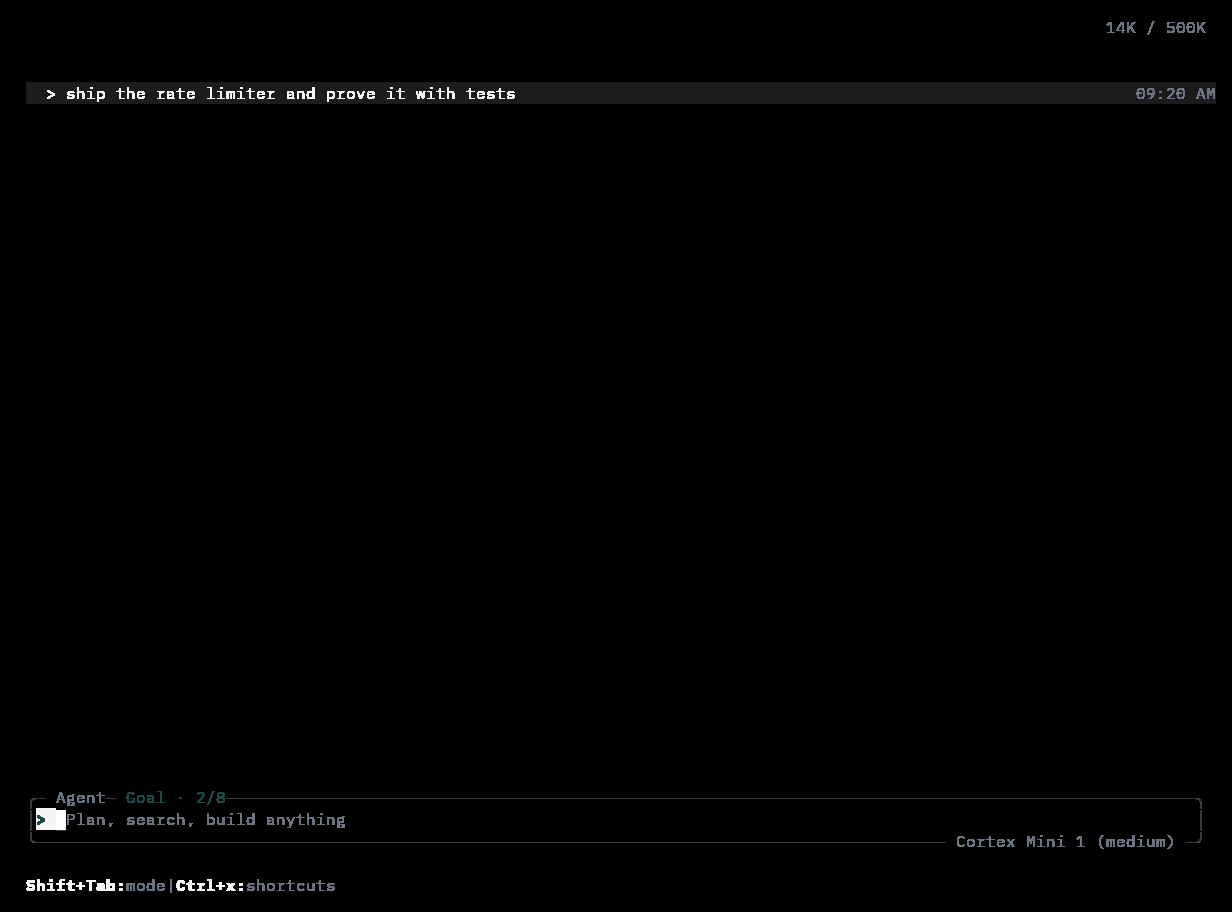
An active goal: the composer border reads Agent — Goal · 2/8 after the kickoff turn “ship the rate limiter and prove it with tests”.
Goal · 2/8 while active, and paused, done, budget, or blocked in the other states.
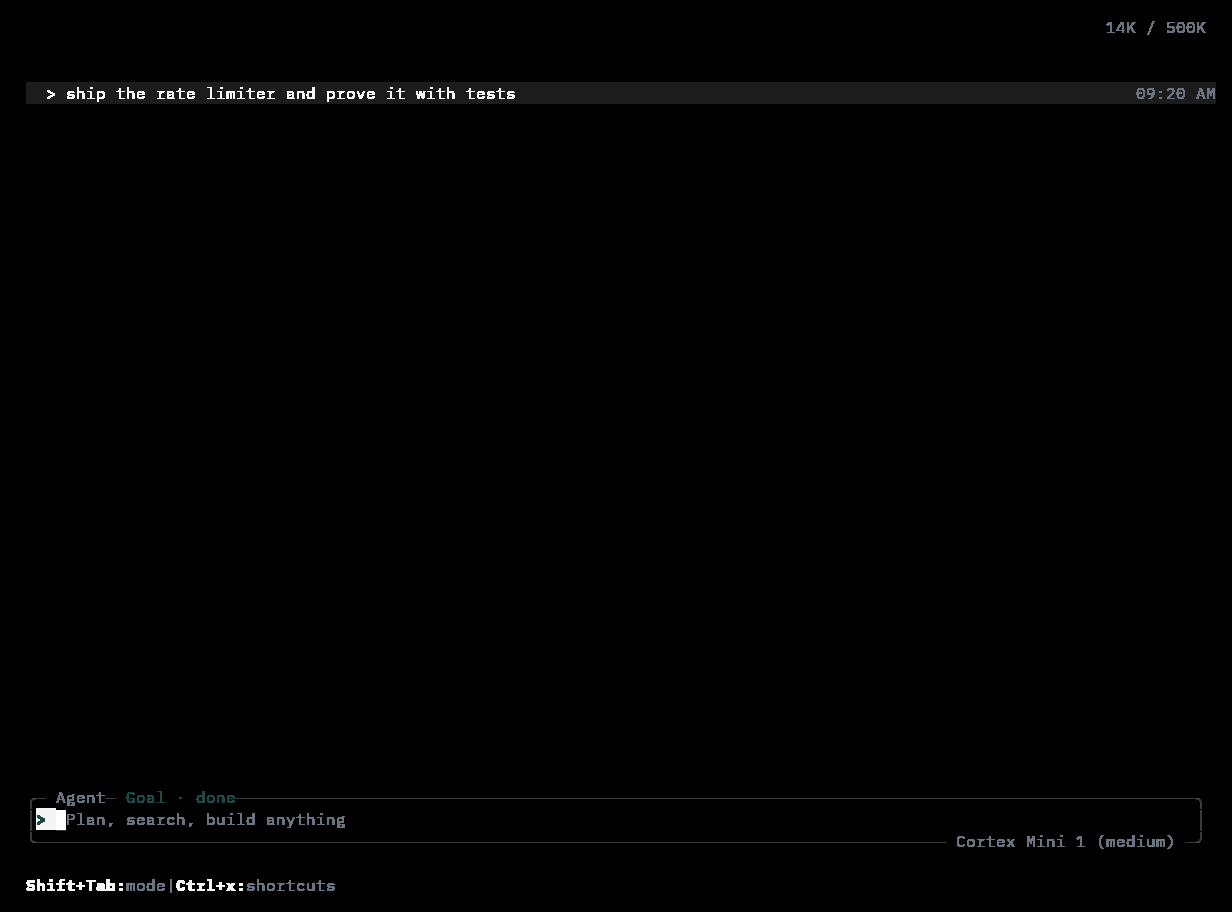
Evidence-complete: the chip reads Goal · done and auto-continuation stops.
States
Evidence, not vibes
Completion is evidence-based. To mark a goal done the model must callUpdateGoal with a reason and at least one of: a file path, a command, or a test. A confident paragraph is not enough.
Budget
The default budget is 8 turns. Near the limit — one turn left, or 85% of a token cap — the next continuation asks the agent to wrap up rather than open new scope.Where it is stored
goal.json lives next to the session files:
When to use a goal
Related
- Modes and permissions — a goal still runs under your approval policy and sandbox.
- Sessions — resume brings the goal back.